
Few things shape the sound of a violin more than proper tuning. Even the finest instrument and the most beautiful bow can only do so much if the strings are out of pitch. Learning how to tune your own violin is one of the most empowering skills a player can develop. It builds independence, sharpens your ear, and ensures that every practice session starts on solid ground. With a little consistency, violin tuning becomes as natural as tightening a bow or setting your shoulder rest.
Here’s everything you need to know about proper violin tuning.
The Standard Tuning for a Violin
The standard tuning for a violin is four open strings tuned in perfect fifths: G – D – A – E. Because the strings are tuned in fifths, meaning each string is a consistent musical distance higher than the one below it, they resonate together in a balanced way.
From lowest to highest in pitch, the strings are:
- G (the thickest, lowest string)
- D
- A
- E (the thinnest, highest string)
These notes are universal across nearly all classical, folk, and modern violin music. When musicians refer to a violin being “in tune,” they mean these four notes are aligned correctly. Whether you’re playing a Bach partita or a bluegrass fiddle tune, your violin starts here.
Understanding Your Tuning Tools
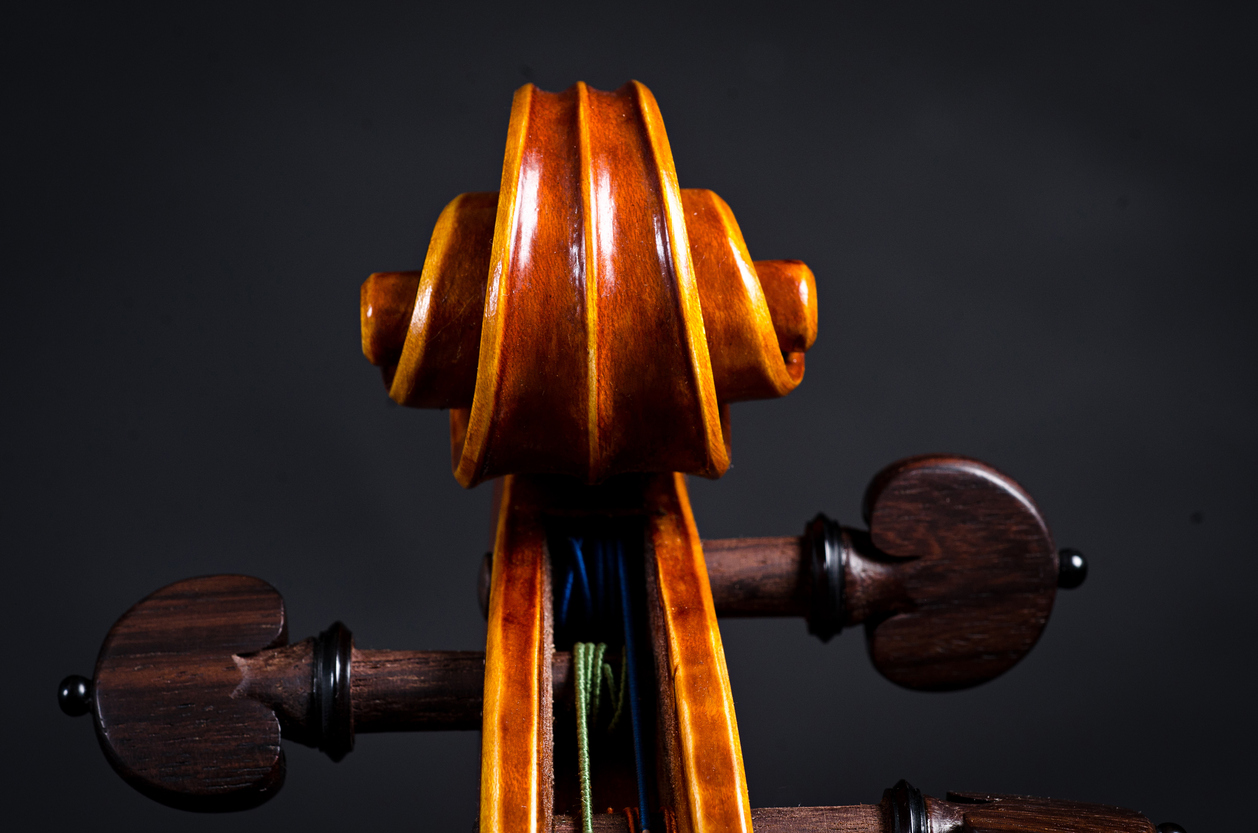
Before tuning, it helps to know which parts of the violin actually control pitch. The wooden pegs at the scroll are used for larger adjustments, bringing each string close to its target note. The fine tuners on the tailpiece are designed for small, precise changes that bring the string perfectly into tune. Most players use both: pegs to get close to their goal pitch, fine tuners to get it just right.

Additionally, pitch is controlled by tension. Tightening a string raises its pitch, and loosening it lowers it. Turning a fine-tuner clockwise (to the right) tightens the string and raises the note, while turning it counterclockwise (to the left) lowers the pitch. Pegs follow the same rule: winding the string tighter raises the note, and unwinding it lowers the note.
Ways to Tune a Violin
There are several reliable ways to bring your violin into tune, and most players use more than one method, depending on their location and the tools available.
1. Tuner-Based Tuning
This is the most common method for beginners and a trusted reference for professionals as well. Digital tuners come in many forms, including handheld tuners, clip-on contact tuners that sense vibration directly through the instrument, and tuning apps on a phone or tablet. All of them listen to the pitch you play and tell you whether you’re sharp (too high) or flat (too low). This visual feedback makes tuning fast, objective, and removes the guesswork from tuning violin strings.
2. Reference-Pitch Tuning
A reference pitch gives you one correct note to match, usually A (440 Hz). This can come from a tuning fork, piano, keyboard, pitch pipe, or even a tuning track or drone played through a speaker or headphones.
Once your A string matches that pitch, you tune the remaining strings by ear, using the natural fifths between them. This method trains your ear and keeps you connected to real acoustic pitch.
3. Tuning by Ear (Matching Pitches)
This is how violinists have tuned for centuries. You start with a known reference, then listen carefully to the way strings interact with each other. When two strings are in tune, their vibrations line up, and the sound becomes clear and steady instead of wobbly or harsh.
How to Tune a Violin With a Tuner
If you’re learning how to tune a violin with a tuner, follow this step-by-step approach:
- Turn your tuner, app, or clip-on device on and set it to “violin” or chromatic mode.
- Start with the A string. Play it with long, steady bow strokes.
- Watch the tuner display to see if the note is sharp or flat.
- If the needle is left of center, the string is flat.
- If it’s right of center, the string is sharp.
- Adjust slowly.
- Use the fine tuners for small changes.
- Use the pegs only if the pitch is far off, turning very carefully.
- When the tuner shows A in the center, move on to D, G, and E.
Always tune up to the note rather than down. If you go past the pitch, loosen slightly and approach it again. This helps the string settle more securely.
How to Tune a Violin with a Tuning Fork or Pitch Source
Strike your tuning fork (or play the A on a piano) and listen carefully. Match your A string to that pitch. Once A is correct, use double stops to tune the other strings:
- Play A and D together.
- Then D and G.
- Then A and E.
When the two strings are in tune, the sound will feel smooth and stable. If it pulses or beats, they’re slightly off.
How to Tune a Violin by Ear: Matching Strings
This method takes practice, but it builds a powerful musical skill. Use your A string as the reference, then tune D to A, G to D, and E to A. Listen for the moment when the sound “locks in.” That clarity tells you the interval is correct.
Additional Violin Tuning Considerations: String Quality and Maintenance
No amount of careful tuning will hold if your strings are worn out or unstable. Old strings stretch unevenly and slip out of pitch quickly. Fresh strings, especially steel-core strings, are far more stable. They hold tuning well, respond quickly to adjustments, and are ideal for players who are still developing their technique.
It also helps to:
- Keep pegs properly fitted and lightly lubricated
- Make sure fine tuners move smoothly
- Wipe rosin off the strings after playing
These small habits protect your tuning and your tone.
Build Confidence With Every Tune at Codabow
The more often you tune your violin, the faster and more accurate you become. Soon, you won’t need to think about it. You’ll simply hear what needs to change and make the adjustment. And once your violin is in tune, everything else feels easier. Notes ring more clearly. Chords sound richer. Practice becomes more satisfying.
Keep your sound crisp and responsive with a high-quality violin bow. Explore CodaBow’s collection to find the bow that matches your style, from beginner-friendly options to performance-grade carbon fiber models. When your instrument is tuned and your bow is balanced, every note has the chance to shine.


