
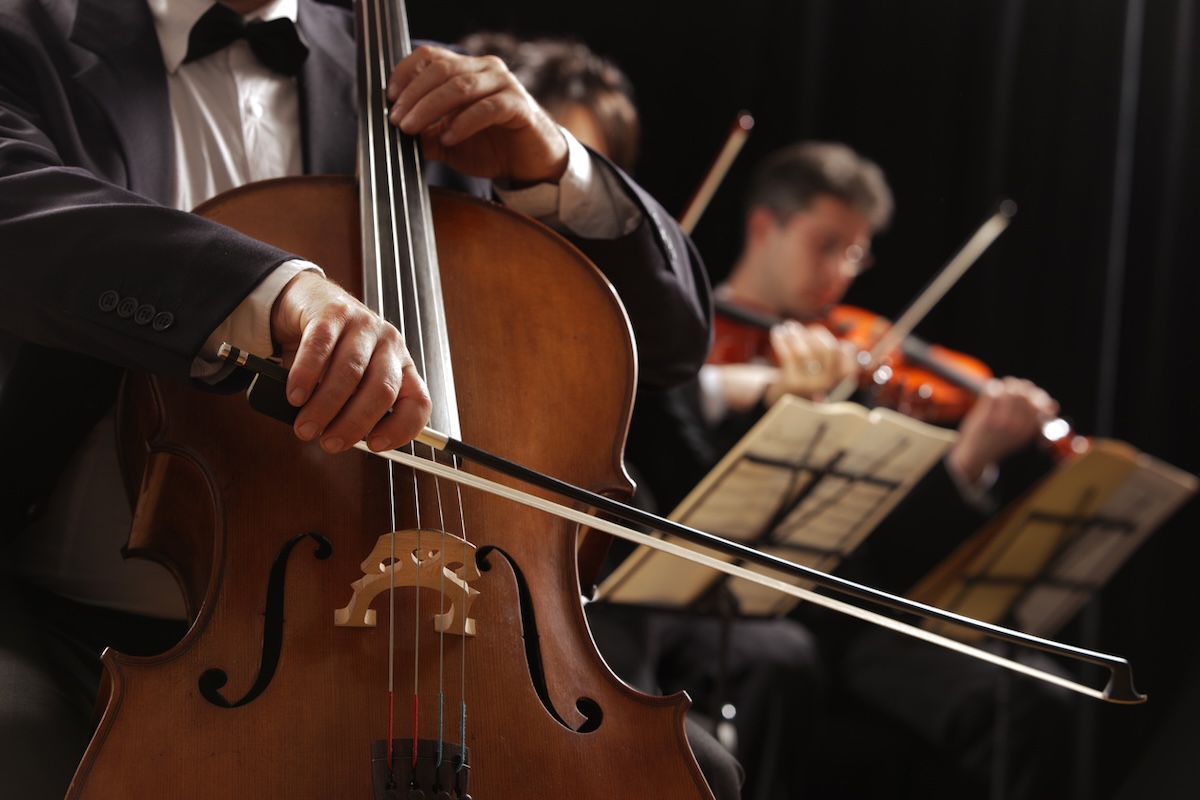
A bowed instrument is any stringed instrument played by drawing a bow across the strings instead of plucking them by hand to create the long, lasting tone this instrument family is known for. That shared playing technique connects instruments used across classical, folk, jazz, and pop music worldwide.
While there are many bowed string instruments across cultures, this guide will focus on the four bowed instruments you’ll find in a traditional orchestra setting. From the violin’s bright upper register to the double bass’s deep foundation, we’ll take a look at each instrument’s size, sound, orchestra placement, and more.
Violin (And Fiddle)
Violins — and by extension, fiddles — are probably the most popular instruments with bows. A violin has four strings: G, D, A, and E. Violins are smaller instruments, and you hold one between your shoulder and chin while using one hand to press the strings against the fingerboard while your other hand draws the bow across them.
How Violins Sound
Violins can produce a bright, clear, expressive sound that ranges from soft and warm to sharp and powerful. In an orchestra, the violin is the highest-pitched member of the main string family, so its sound often stands out.
Because they’re so versatile, violins are used in many styles of music, including classical, orchestral, folk, country, jazz, and pop. In folk and country music, the violin may be referred to as a fiddle, but it’s the same instrument. The difference lies in how you play it.
Where Violins Sit in an Orchestra
In an orchestra, the violins usually sit at the front of the string section, closest to the conductor.

They’re divided into two groups:
- First violins typically sit to the conductor’s left and often play the highest notes, melodies, and prominent musical lines.
- Second violins sit next to or just behind the first violins and often play harmonies, supporting lines, and rhythmic parts.
The exact seating arrangement can vary by orchestra, but violins are almost always positioned near the front because they’re a major part of the ensemble’s sound.
Violin Bows
A violin bow plays a major role in how the instrument responds and sounds. Its weight, balance, stiffness, and materials can all affect control, articulation, and tone. The right bow is an important part of a violinist’s setup.
Most bows are made with either a traditional wood stick or a modern carbon fiber stick, with horsehair stretched from the frog to the tip. Sizes vary depending on the player and violin size.
Viola
A viola looks very similar to a violin but has a slightly larger body and a lower, warmer sound. Its strings are tuned C, G, D, and A.
Like the violin, you hold the viola between your shoulder and chin and play it with a bow. You can learn more about the differences and similarities between the two in our article comparing violins and violas.
How Violas Sound
Because violas have a larger body and lower tuning, they produce deeper, richer tones and often fill the middle range of an orchestra’s string section.
Violas usually provide harmony, inner musical lines, and rhythmic support, but they can also play melodies and solo passages.
Where Violas Sit in an Orchestra
In an orchestra, violas usually sit near the center of the string section, between the violins and cellos.
They’re commonly positioned inside or just right of the violins and in front of or beside the cellos. However, they may sit directly opposite the violins in a non-antiphonal seating model. Violas also sit relatively close to the conductor to help connect the higher violin parts to the lower cello and bass parts.
Viola Bows
Viola bows may also be made from wood or carbon fiber and use horsehair stretched from the frog to the tip.
Because the viola has thicker strings and a larger body than the violin, its bow is designed to provide more weight and strength. That added mass helps players draw out the viola’s deeper, warmer tone while maintaining control.
Cello
A cello is much larger than the violin and viola. Its four strings are tuned to C, G, D, and A, which are the same notes as the viola. The cello is just an octave lower.
Unlike the violin and viola, you play the cello while seated. The instrument rests upright between your knees and is supported by an endpin that sits on the floor.
If you want to learn more about choosing between the cello and violin, you can visit our blog post comparing the two.
How Cellos Sound
Cellos are known for their rich, warm, resonant sound and wide range. In an orchestra, they can provide bass support and harmony, but they also frequently play melodies and expressive solo passages.
Where Cellos Sit in an Orchestra
Cellos usually sit near the front of the string section to the conductor’s right and opposite the first violins. They are also often in front of the double basses and beside the violas, but exact arrangements can vary by orchestra. The cellos help connect the middle-range violas with the deeper tones of the basses.
Cello Bows
Despite the fact that cellos are much larger than violins, a cello bow is actually shorter than a violin or viola bow. However, cello bows are heavier, as the added weight helps the bow grip the cello’s thicker strings.
Just like other orchestral bows, a cello bow may be made from wood or carbon fiber with horsehair.
Double Bass
A double bass is the largest and lowest-pitched instrument in the traditional orchestral string family. It typically has four strings tuned to E, A, D, and G.
Because of its size, you play the double bass upright, with the instrument supported by an endpin on the floor. You can either stand or sit on a tall stool while playing.
How the Double Bass Sounds
The double bass produces a deep, powerful, resonant sound and usually supports the orchestra with bass lines, rhythm, and harmonic foundation. It’s also widely used outside classical music, especially in jazz, bluegrass, folk, and other acoustic styles.
Where the Double Bass Sits in an Orchestra
Double basses usually sit at the back of the string section, often behind the cellos and toward the conductor’s right.
Like the other string instruments, their exact placement can vary, but they’re typically grouped together along the rear edge of the orchestra. This position helps their lower sound support and blend with the rest of the strings.
Double Bass Bows
Bass bows tend to be shorter and heavier than those of violins, violas, and cellos. When it comes to the bass, you have two main bow styles: French and German. French bows are held more overhand (similar to a cello bow), while German bows have a larger frog and are held with an underhand grip.
Which Bowed Musical Instrument Should You Choose?
If you’re interested in picking up a bowed instrument, the best option depends on the sound you like, how you want to play, and the type of role you want in an ensemble.
- Choose the violin if you like bright, expressive melodies and want an instrument with a vast repertoire spanning classical, folk, pop, and other styles.
- Choose the viola if you prefer a warmer, deeper sound and enjoy playing harmonies and inner musical lines.
- Choose the cello if you’re drawn to rich, resonant tones and want an instrument that can move easily between bass support, harmony, and melodic parts.
- Choose the double bass if you love deep, powerful sounds and like providing the rhythmic and harmonic foundation of an ensemble.
You should also consider instrument size and portability. Violins and violas are easier to transport, while cellos and double basses require more space. Ultimately, you should choose the instrument with the sound and playing style that make you the most excited to practice.
Violin vs.Viola vs. Cello vs. Double Bass |
||||
|---|---|---|---|---|
| Violin | Viola | Cello | Double Bass | |
| Sound | Bright and expressive, the highest-pitched in the string section | Warmer and deeper than the violin, with a rich middle-range tone | Rich and resonant with a wide range | Deep and powerful, the lowest notes in the string section |
| Size | Smallest of the four; light and easy to carry | Slightly larger than the violin, with a longer body and strings | Much larger than the violin and viola; played upright between the knees | Largest of the four; usually played standing or on a tall stool |
| Orchestra Placement | Front left of the section, closest to the conductor | Center of the section, between the violins and cellos | Front right of the section, opposite the first violins | Back of the section, behind the cellos |
| Playing Considerations | Compact and approachable to hold | Similar technique to the violin, with a longer reach | A new seated posture and bow angle to learn, with wide stretches in the lower positions | Larger stretches and more hand strength required than the other three |
No Matter Your Instrument, CodaBow Has You Covered
Whether you’re playing folk songs on the fiddle or sitting in the cellist’s chair in an orchestra, the right bow makes all the difference. CodaBow crafts carbon fiber bows for the violin, viola, cello, and bass, so you can feel confident in every practice session and performance. Explore our full collection today and request an In-Home Trial to find the bow built for your sound.


