
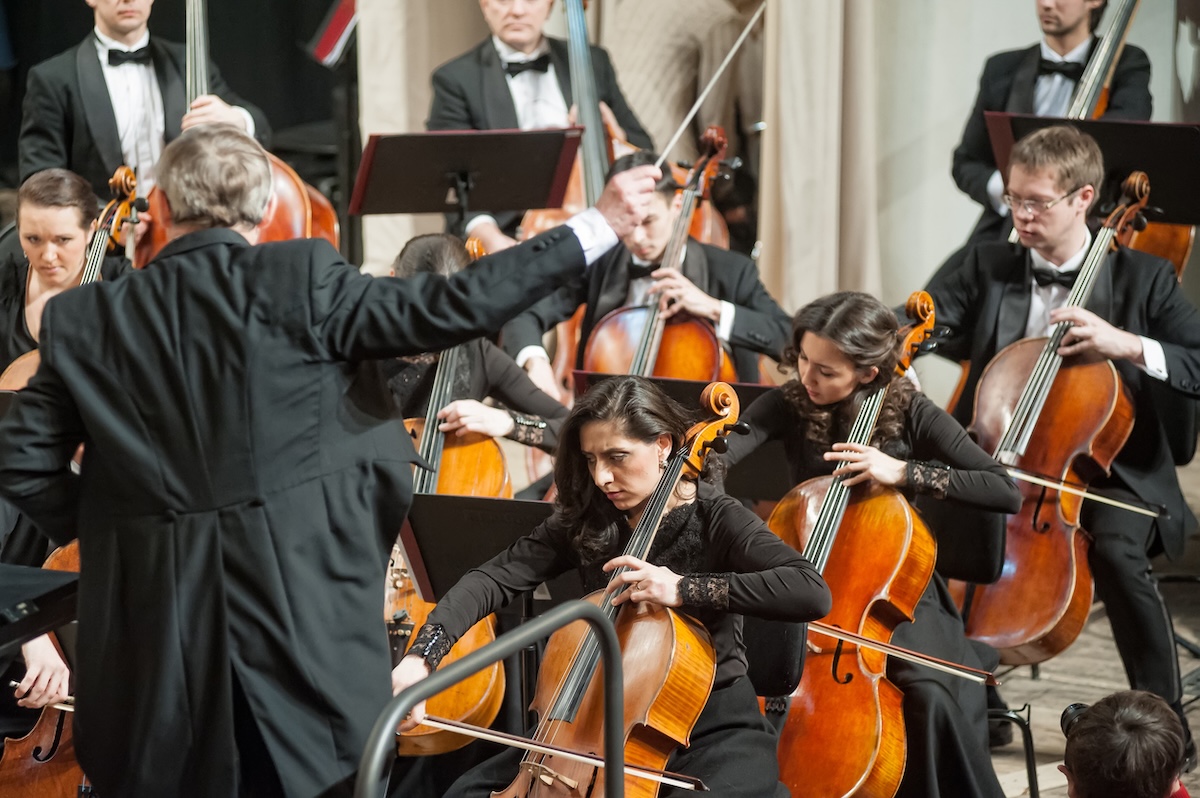
The seating assignments in any concert hall are intentional. Every chair, from the conductor’s podium to the back row of percussion, reflects both a musician’s instrument and their level of responsibility within the group. These orchestra roles shape how the music comes together on stage and how players advance over the course of a career.
In this guide, we’ll walk through each section of the orchestra and explain how its positions are ranked and earned.
Orchestra Sections
Before you can understand the positions and hierarchy of the orchestra, you first need to know what sections and instruments are included. While exact makeup varies from orchestra to orchestra, you can generally expect to see:
Strings Section
The strings section is often considered the foundation of an orchestra, and it’s the largest group. Between all the violins, violas, double basses, and cellos, the strings tend to make up more than half of an orchestra’s musicians.
Because the strings are so foundational, they sit at the front of the orchestra, closest to the conductor.
Woodwind Section
The woodwind section usually sits in the middle behind the strings (typically the violas). This section is comprised of flutes, clarinets, bassoons, and oboes. While the woodwind section has the same number of instrument types as the strings, there are generally only one or two musicians per part.

Brass Section
The brass players sit behind the woodwinds. In this section, you’ll find the French horns, trumpets, trombones, and tubas. The exact number of brass parts can vary, but the majority of them tend to go to the French horns.
Percussion Section
At the back of the orchestra is the percussion section. This is the most diverse section, encompassing instruments like the cymbals, timpani, xylophone, triangle, bass drum, and specialty instruments.
The makeup of the percussion section depends on the repertoire performed. While a wide range of instruments may be needed, there’s not necessarily one player assigned to each one. A percussion member may be responsible for multiple instruments.
Common Positions in an Orchestra
Every member of the orchestra is crucial to the success of each performance, but there is a defined hierarchy.
The Conductor
At the top of the orchestra hierarchy is the conductor. They are the ultimate artistic authority, responsible for selecting repertoire, determining interpretations, and leading rehearsals. During performances, they control the tempo and volume.
While this role doesn’t involve playing an instrument, the conductor is critical to a unified performance.
The Concertmaster
The concertmaster is essentially the second-in-command of the entire orchestra. They are the leader of the first violins and are in charge of pre-concert tuning, deciding bowing techniques for the strings, and acting as a liaison between the conductor and other players.
Principal Players
Principal players, or section leaders, are the head musician for each instrument group. So, there’s a principal cello, principal oboe, principal French horn, and so on. They usually play solos along with guiding their subsection’s phrasing and articulation.
Section Players
At the “bottom” of the hierarchy are the section players. These are the musicians who follow their principals’ lead and play the core harmonic or rhythmic parts.
In the strings section, there’s even hierarchy among the section players. The players closest to the front, called the “first stand,” have the most responsibility and help lead the players behind them.
How Are Roles in an Orchestra Determined?
A player’s position within an orchestra is usually determined through auditions, seniority, and the conductor’s vision. A newer professional will likely join an orchestra as a section player, with the opportunity to advance throughout their career. However, section leaders tend to stay in their roles for years or even decades, so moving up the hierarchy may require changing orchestras.
Example Career Path Through an Orchestra
Let’s look at a violin player as an example, since they are the only part to have the opportunity to grow into a concertmaster.
A violinist fresh out of music school can join an orchestra as a section player and be seated toward the back of their section. They may work their way up to a “first stand” position before eventually landing a role as the concertmaster, either in their current orchestra or by joining a new one with an opening. From there, the violinist may continue to advance by joining better orchestras, or they might climb to a role like conductor or music director.
The Bow Orchestra Musicians Count On
From the concertmaster’s chair to the back of the section, every orchestra musician deserves a bow built for consistency and control. Explore CodaBow’s full lineup across violin, viola, cello, and bass, and find the bow that fits your seat.


