
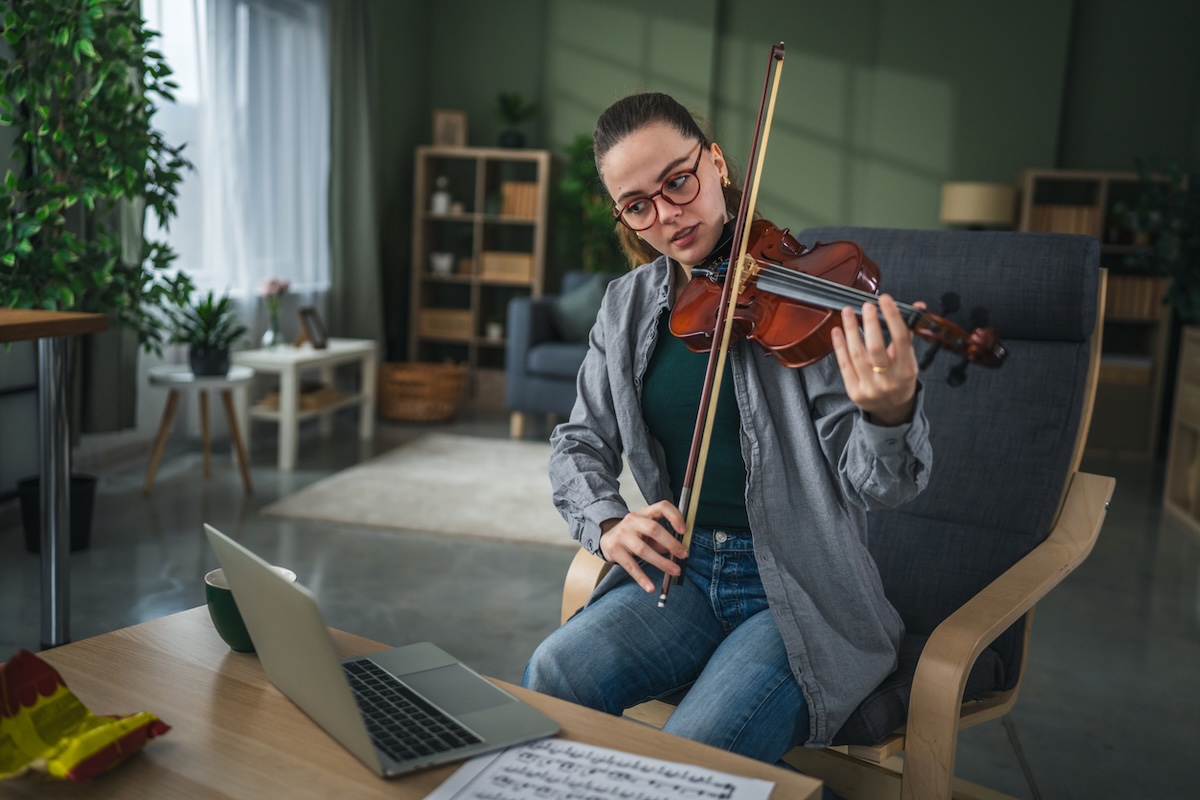
No, it’s not too late for you to learn the violin. Adult beginners can become just as skilled and expressive of players as younger students.
Practice and dedication are critical to learning the violin, and adults can bring both. While starting later in life comes with some challenges, adults have several learning advantages too. In one study, 29.3% of violin teachers surveyed reported that adults grasp concepts and objectives more quickly than children. The age question isn’t as black-and-white as it may appear.
In this guide, we cover how learning the violin as an adult differs from starting as a child, along with the advantages and disadvantages that come with learning later in life. We also share an approximate roadmap of what adult beginners can expect.
The Main Differences When Learning Violin as an Adult
Adults and children bring different strengths to violin lessons. Children may progress faster because their auditory and motor systems are still developing, though this isn’t a fixed rule. Adults, on the other hand, tend to have stronger analytical skills, independence, a more deliberate approach, and clearer goals.
An early start can be particularly advantageous for students pursuing a professional career. However, starting young doesn’t guarantee success, and starting “late” doesn’t mean poor results. For both kids and adults, consistent practice, motivation, quality instruction, and sustained engagement with the instrument strongly shape progress.
Advantages of Learning Violin as an Adult
By adulthood, most people have spent years picking up new skills. Adults can draw on significant experience solving problems, mastering unfamiliar tasks, responding to constructive criticism, and figuring out which learning strategies work for them. While these skills don’t transfer directly to bow control or intonation, they help adults solve unfamiliar problems and work methodically toward new techniques.

Adults have essentially learned how to learn, which often brings advantages such as:
- Analytical and problem-solving skills
- Broad experience in learning difficult skills
- Intrinsic motivation
- Knowing their strengths and weaknesses
- Greater capacity for self-assessment
- Better ability to understand and apply feedback
- Independence in time management and organization
- Higher tolerance for frustration
These traits become especially important when progress slows. As an adult beginner, you may be more open to analyzing the problem with a teacher and adjusting how you practice, such as by breaking a difficult technique into manageable steps. And because you chose to play, you can lean on intrinsic motivation when the difficulty increases.
Disadvantages of Learning Violin as an Adult
Starting age can affect how much practice time you accumulate and, in some cases, your ability to become a professional violinist. But it doesn’t set an age cutoff for meaningful musical development, as one study examining older adults has shown.
Some of the hurdles you may face as an adult learner include:
- Finding consistent time for daily practice
- Accepting beginner-level results
- Developing unfamiliar coordination and movement patterns
- Tension while playing, especially in the left hand
- Maintaining motivation and avoiding musician burnout without external structure
- Previous injuries affecting movement and coordination
- Less of the carefree approach children often have
- Overanalyzing mistakes or comparing yourself to experienced players
The primary challenges of learning the violin as an adult have less to do with ability and more to do with time and consistency. If you stay consistent in your practice, you can work through many of the other hurdles.
Support and accountability can also be harder for adults to find, but this varies greatly from person to person. Younger students get structure from parents and school programs. Adult players can build the same structure with regular violin lessons, scheduled practice, teacher feedback, and a focus on achievable goals.
A Realistic Timeline for Becoming Skilled at the Violin
Everyone progresses at a different pace, depending on how consistent their instrument practice is, how much time they can commit, the quality of their instruction, and their individual goals. Still, a rough timeline can help you picture what your progress might look like:
- First 1–3 months: Correct violin posture, violin hold, bow hold, and first simple rhythms on open strings. You may also begin reading basic notation and learning your first easy melodies. However, don’t expect a clear, consistent sound just yet.
- Next 3–6 months: You’ll start developing better coordination between your left hand on the strings and your right hand’s bow technique. You might also start working on simple scales, improve basic intonation, gain more control over string crossing, and learn a more varied beginner repertoire.
- Around 6–12 months: You may be playing a wider range of beginner repertoire and reading music much more comfortably. Your tone consistency is likely to improve, and you may start to feel more in control of intonation and dynamics.
- Around 1–2 years: This is where things get more interesting, as your tone and repertoire are likely to improve noticeably. Depending on your development and your teacher’s approach, you may start learning vibrato and shifting. More advanced bowing techniques often come next.
- 3 years and beyond: You’ll be able to play increasingly sophisticated repertoire and refine advanced bow strokes, vibrato, shifting, phrasing, tone, and more.
Keep in mind that these milestones are a general guide. Everyone’s path will vary, and with an instrument like the violin, every step is worth savoring. Instead of comparing yourself to others, enjoy the process and notice your own progress as you grow into a true violinist.
It’s Never Too Late to Learn Violin
Learning violin as an adult takes consistent practice and the patience to sound like a beginner before you sound like the violinist you want to become. But there is no expiration date on developing meaningful musical skills.
The right bow can make those first steps feel more natural from day one. Explore CodaBow’s carbon fiber student and step-up bow models to find a bow that grows with you as your playing develops.


